
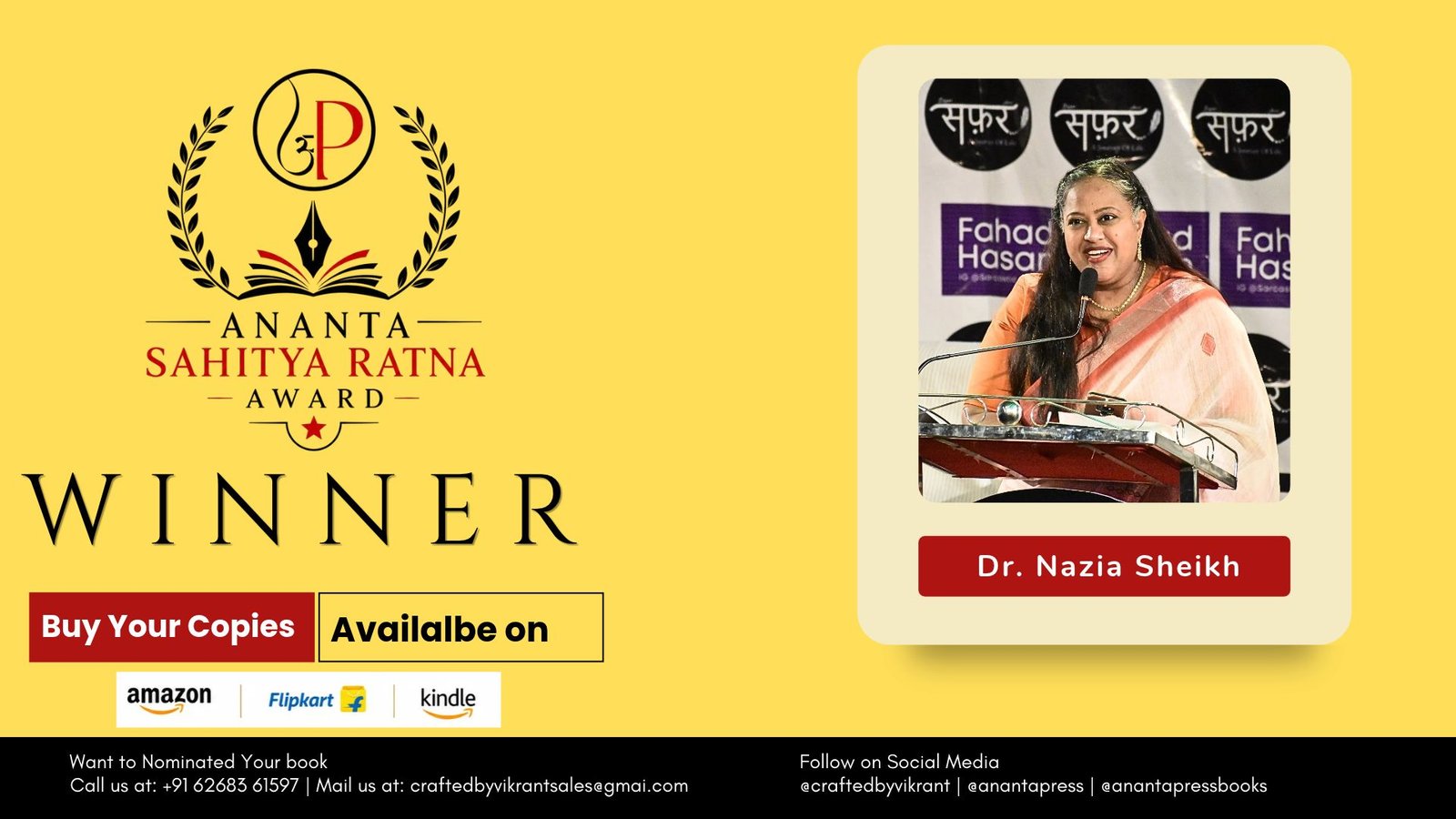
Ananta Press proudly congratulates Dr. Nazia Sheikh on being recognised as an official Winner of the prestigious Ananta Press Sahitya Ratna Award for her poetry collection, “दश्त-ए-सुख़न.” This recognition celebrates her contribution to Hindi and Urdu poetry and her ability to transform personal emotions into meaningful literary expressions that connect with readers from different walks of life.
“दश्त-ए-सुख़न” is a thoughtful collection of poems exploring love, separation, longing, resilience, hope, and self-reflection. Through its emotional depth and expressive language, the book offers readers an opportunity to revisit their own memories, understand their feelings, and discover comfort in the shared experiences of human life.
A Literary Voice That Speaks to the Heart
Poetry has always played an important role in expressing emotions that ordinary conversations cannot fully capture. Dr. Nazia Sheikh brings this understanding to “दश्त-ए-सुख़न,” creating a literary space where feelings find expression and silence carries meaning.
One of the collection’s most significant qualities is its ability to make deeply personal emotions feel universal. The poems explore experiences that are familiar to almost everyone, whether it is the happiness of love, the pain of separation, the uncertainty of longing, or the strength required to move forward.
Rather than depending entirely on elaborate language, the collection places emotional honesty at the centre of its literary identity. Its poetic approach recognises that meaningful writing does not always require complicated expressions. Sometimes, the simplest emotions leave the deepest impressions.
This balance between literary richness and emotional accessibility makes “दश्त-ए-सुख़न” especially relevant to contemporary readers.
Celebrating the Beauty of Hindi and Urdu Poetry
Another distinguishing feature of “दश्त-ए-सुख़न” is its connection to the expressive traditions of Hindi and Urdu literature.
Both languages possess remarkable poetic histories, particularly in their exploration of love, longing, memory, and human relationships. Dr. Nazia Sheikh draws upon this literary beauty while presenting themes that remain relevant to modern life.
The collection aims to welcome both experienced poetry readers and individuals discovering poetry for the first time. Its emotional imagery, thoughtful expressions, and quiet intensity encourage readers to engage with poetry as a personal experience rather than merely an artistic form.
By making meaningful poetic expression approachable, the book contributes to the continued appreciation of Hindi and Urdu literature among a wider readership.
Recognition by the Ananta Press Sahitya Ratna Award
The Ananta Press Sahitya Ratna Award celebrates authors whose literary contributions demonstrate creativity, meaningful expression, originality, and the ability to connect with readers.
The recognition of “दश्त-ए-सुख़न” reflects the qualities that make the collection worthy of literary appreciation. Its exploration of universal emotions, its connection with Hindi and Urdu poetic traditions, and its emphasis on authenticity establish a meaningful basis for the award committee’s recognition.
The book’s central message is particularly important: readers do not approach poetry only to appreciate beautiful words. They also seek to understand themselves.
This belief forms the emotional foundation of Dr. Nazia Sheikh’s collection. The poems are intended to offer companionship through moments of happiness, uncertainty, solitude, and healing.
At a time when many people seek emotional understanding and connection through literature, works such as “दश्त-ए-सुख़न” remind us of poetry’s continuing relevance.
A Meaningful Contribution to Contemporary Poetry
The literary appeal of “दश्त-ए-सुख़न” extends beyond its individual themes. Its greater contribution lies in bringing these emotions together within a collection that values sensitivity, reflection, and human connection.
Love and separation are timeless subjects, but each generation discovers new ways to experience and express them. Dr. Nazia Sheikh’s writing seeks to give these familiar emotions a personal voice while allowing readers to find their own interpretations.
The collection also recognises the importance of resilience and hope. It acknowledges emotional struggles without overlooking the possibility of healing and personal growth.
Such qualities make poetry more than a source of artistic enjoyment. They allow it to become a companion during important moments in a reader’s life.
Congratulations and Best Wishes
Ananta Press extends its heartfelt congratulations to Dr. Nazia Sheikh on being honoured as a Winner of the Ananta Press Sahitya Ratna Award.
Her achievement celebrates the creative spirit behind “दश्त-ए-सुख़न” and recognises the lasting importance of literature that speaks honestly about human emotions.
Through this collection, Dr. Nazia Sheikh reminds readers that every feeling deserves understanding, every silence can carry meaning, and every personal experience can become part of a larger human story.
We sincerely wish her continued success in her literary journey and look forward to seeing her creative voice reach and inspire many more readers.
Congratulations, Dr. Nazia Sheikh, on this wonderful literary achievement.
Ananta Press Sahitya Ratna Award
Celebrating Literary Excellence, Creativity, and Meaningful Contributions to Literature.
Proposed Jury Member Feedback
The following six passages are individual editorial drafts prepared from the book description. Each must be reviewed and approved by the respective jury member before being published under their name.
1. Glenville Ashby
What stands out to me about दश्त-ए-सुख़न is its effort to make private feelings meaningful to a wider audience. Love, separation, and longing are familiar subjects in poetry, but they continue to matter when the emotions behind them feel sincere. This collection is presented as poetry that invites readers to recognise their own experiences rather than simply admire beautiful language. I consider that an important literary strength.
Its attention to silence and to feelings that remain unspoken is particularly appealing. Often, the moments we cannot explain clearly stay with us the longest. A poem that gives those moments a gentle shape can offer genuine comfort.
I also appreciate the collection’s intention to remain accessible without losing the beauty of Hindi and Urdu expression. Such a balance helps poetry reach different kinds of readers. For me, the value of this work lies in its respect for ordinary human emotion and its belief that personal stories can create a shared understanding.
2. Kavya Pandey
The literary identity of दश्त-ए-सुख़न comes from the meeting of Hindi and Urdu expression with emotions that readers can easily understand. That combination is especially valuable because poetry should welcome new readers while still offering depth to those who return to it often.
The collection centres on love, memory, solitude, and reflection, and these are experiences that cut across age and background. I am drawn to the way the book is described as giving importance to emotional honesty rather than complicated language for its own sake. Beautiful words can attract attention, but honest feeling is what makes a poem stay in the mind.
Its focus on evocative images and quiet intensity also suggests a thoughtful creative direction. I appreciate writing that leaves room for readers to form their own meanings. In my assessment, the collection’s strongest promise is that its language does not place distance between the writer and the reader. Instead, it seeks to bring them closer through feelings they may already know.
3. Apeksha Gupta
I find the emotional range of दश्त-ए-सुख़न especially meaningful. The collection does not limit itself to the happiness of love or the pain of separation. It also gives space to resilience, hope, and self-reflection. This matters because real emotional life is rarely simple.
A person can feel loss and strength at the same time, or experience loneliness while slowly moving towards healing. Poetry that recognises these mixed feelings can make readers feel understood.
I value the idea that this book can accompany someone through different stages of life, offering fresh meaning when they return to it later. Its emphasis on what remains unspoken is another important part of its appeal.
Not every feeling needs a direct explanation to be understood. Sometimes a quiet image can express more than a long statement. To me, this collection speaks to readers looking for connection and reassurance, while also encouraging them to think more deeply about their own emotional journeys.
4. Kavita Kaushik
What I appreciate most about the direction of दश्त-ए-सुख़न is the importance it gives to simplicity without sacrificing literary beauty. Good poetry does not need to be difficult to be memorable. It needs to express something true, and to do so in a way that readers can feel.
The collection’s Hindi and Urdu character gives it a distinctive voice, while the themes of love, distance, hope, and solitude make that voice relatable.
I am particularly interested in its treatment of silence. In everyday life, people often leave their most important emotions unspoken. Poetry offers a place where those emotions can be acknowledged with care.
The book’s stated reliance on imagery and quiet intensity supports that aim. It also offers an inviting entry point for people who may feel that poetry is not for them.
I see value in literature that does not create a barrier between artistic expression and human understanding. This collection aims to build a bridge between the two.
5. Neel Preet
For me, the most appealing quality of दश्त-ए-सुख़न is its understanding of why people return to poetry. Readers may begin with a beautiful line, but they often stay because a poem reminds them of their own lives.
The collection is shaped around that relationship between the writer’s inner world and the reader’s personal memories. Its subjects, including longing, separation, hope, and reflection, are familiar, but familiarity can become a strength when handled with care. These feelings connect people who may otherwise have very different stories.
I also appreciate the idea of poetry as a companion rather than a lesson. A reader facing loneliness may find comfort in one poem, while another may find the courage to reflect on a difficult memory.
The blend of Hindi and Urdu adds cultural texture to this emotional connection. I believe the book’s central message is that being understood can begin with something as simple as recognising our feelings in another person’s words.
6. Deepak Seth
दश्त-ए-सुख़न offers a clear and worthwhile literary purpose: to turn personal emotion into an experience that many people can share. In considering poetry, I place importance on both expression and relevance. A collection should have its own voice, but it should also give readers a reason to return to its pages.
The themes presented here have that potential because love, loss, and resilience are not tied to a single moment in life. Their meanings can change as readers grow older or encounter new experiences.
I find the emphasis on honest feeling particularly important. Elaborate vocabulary alone cannot create a lasting connection. The real achievement of poetry lies in helping us see something familiar with renewed attention.
The book’s accessible use of Hindi and Urdu supports that aim and may encourage readers who are just beginning to explore poetry. Its focus on healing and reflection also offers a positive contribution.
I see this collection as an invitation to listen more carefully to our own hearts and to others.