
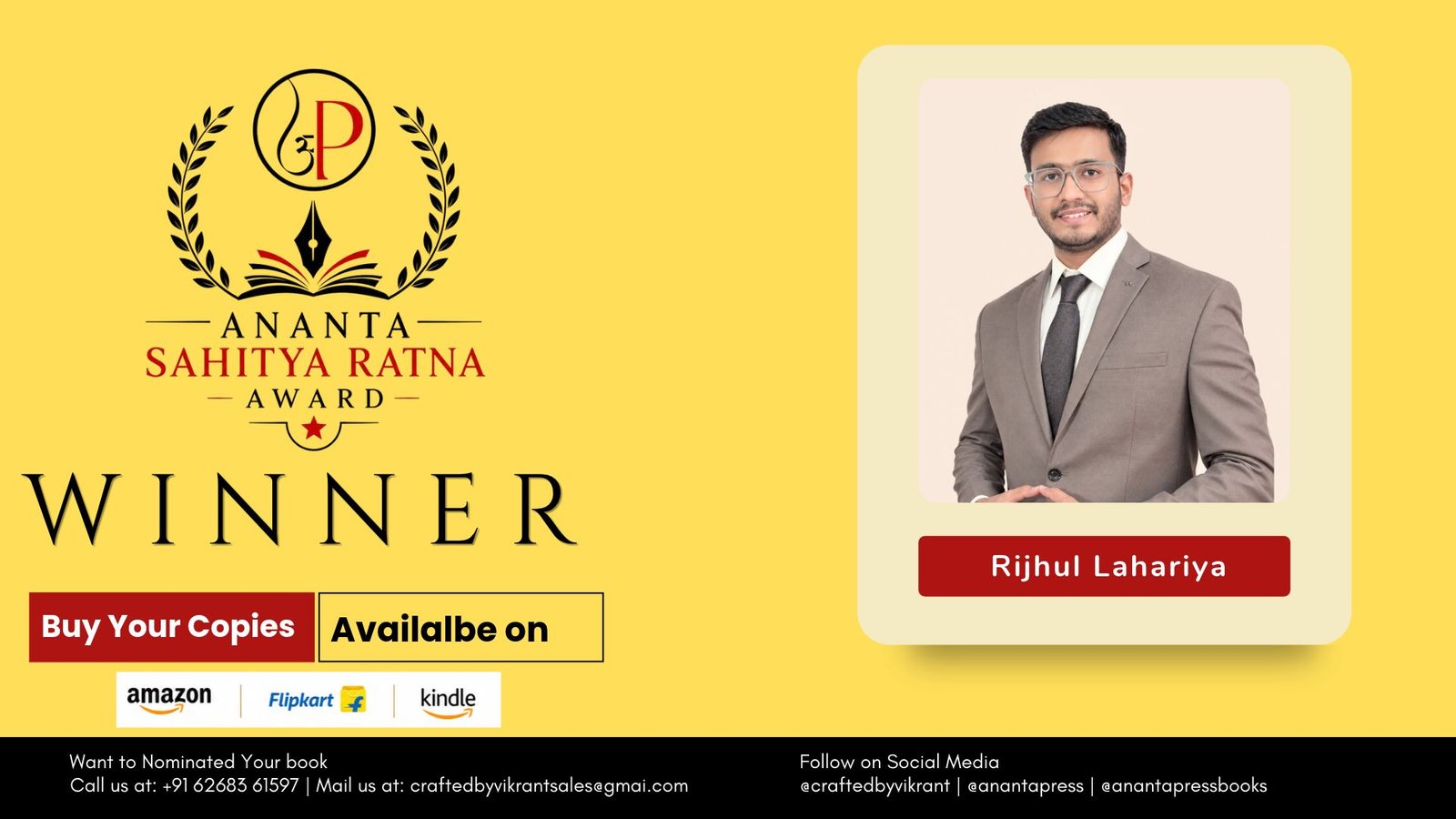
Ananta Press proudly congratulates Dr. Rijhul Lahariya on being named a Winner of the Ananta Press Sahitya Ratna Award for his remarkable book, The Brain Within: How The Brain Shapes Time. This recognition celebrates an author whose writing brings together scientific knowledge, human understanding, and a fresh perspective on one of life’s most familiar yet mysterious experiences: time.
Every person experiences time differently. A few minutes of pain can feel endless, while hours of happiness can pass almost unnoticed. Through his book, Dr. Lahariya explores why this happens and how the human brain shapes our understanding of the past, present, and future.
His work encourages readers to see time not simply as something measured by clocks, but as an experience created through the interaction of the brain, body, emotions, memories, and everyday life.
A Book That Changes How We Understand Time
The Brain Within: How The Brain Shapes Time offers an engaging exploration of neuroscience and human experience. Rather than presenting time as a fixed concept, the author explains how our perception changes according to attention, emotional states, physical conditions, and neurological processes.
One of the book’s most interesting ideas is that the brain does not rely on a single internal clock. Instead, different neural systems work together to create our experience of time.
The chapters introduce readers to important areas of the brain, including the hippocampus, cerebral cortex, cerebellum, basal ganglia, insula, and prefrontal cortex. Dr. Lahariya explains their roles through relatable examples, helping readers understand complicated scientific ideas without requiring a background in neuroscience.
The book also explores why painful memories can seem close even after many years, why anxiety can make life feel rushed, and why people experiencing emotional difficulties may struggle to imagine a meaningful future.
These discussions give the book importance beyond scientific education. They connect neuroscience with everyday challenges, personal growth, emotional well-being, and human relationships.
An Author Connecting Scientific Research With Human Experience
Dr. Rijhul Lahariya is an emerging physician-scientist, author, and interdisciplinary researcher whose interests bring together neuroscience, artificial intelligence, computational biology, and clinical medicine.
His research explores neurological function and disease, including neuroinflammation, brain-immune interactions, infectious neurology, and neuro-oncology. His wider scientific interests also include cognitive ageing, neurodegeneration, and computational approaches to medical research.
This broad academic perspective is reflected in The Brain Within. Dr. Lahariya approaches a complex subject with scientific curiosity while keeping the experiences of ordinary people at the centre of his writing.
What makes his approach especially valuable is his ability to connect research with questions that readers may have experienced but never fully understood.
Instead of simply explaining how the brain functions, he asks readers to reconsider how they experience their own lives.
Why This Book Deserves the Ananta Press Sahitya Ratna Award
The Ananta Press Sahitya Ratna Award celebrates meaningful literary contributions, original ideas, and writing that offers lasting value to readers.
The Brain Within stands out for several reasons that support its recognition.
First, the book explores an unusual and important subject. Time perception influences human behaviour, memory, motivation, emotional health, and personal identity. By examining these connections, Dr. Lahariya offers a perspective that encourages both learning and self-reflection.
Second, the book presents scientific concepts in clear, approachable language. Everyday situations involving waiting, happiness, suffering, memory, and anticipation become starting points for understanding the brain.
Third, its message encourages greater empathy. The author suggests that difficulties involving motivation, emotional recovery, or a sense of being stuck may sometimes be better understood by considering how a person experiences time.
Another significant quality is the book’s thoughtful structure. It begins with the foundations of lived time, introduces the brain’s contributing systems, explores how time perception can become disrupted, and finally considers how people may regain a stronger sense of continuity and meaning.
The chapters Healing Through Re-Timing the Lived Moments and Living in Brain Time offer a particularly thoughtful conclusion. They encourage readers to consider the importance of manageable experiences, meaningful progress, and supportive human relationships.
These qualities provide a strong literary and intellectual basis for the book’s nomination and selection.
A Meaningful Contribution to Contemporary Nonfiction
The strength of The Brain Within lies in its combination of scientific explanation and reflective writing.
The author does not simply provide information. He builds a conversation with readers, asking questions that invite curiosity and deeper understanding.
Its value is especially relevant today, when many people struggle with stress, burnout, emotional pressure, and the feeling that time is constantly slipping away.
The book encourages readers to develop a more compassionate understanding of themselves and others. It also offers useful perspectives for caregivers, students, researchers, and anyone interested in the relationship between the human brain and everyday life.
By making a complex subject approachable and meaningful, Dr. Lahariya contributes to contemporary nonfiction writing and the wider public understanding of neuroscience.
A Well-Deserved Recognition and a Promising Journey Ahead
The Ananta Press Sahitya Ratna Award recognises the importance of books that leave readers with new knowledge, thoughtful questions, and meaningful perspectives.
Through The Brain Within: How The Brain Shapes Time, Dr. Rijhul Lahariya has demonstrated that scientific writing can be informative, accessible, and deeply connected to human experience.
His achievement represents the value of intellectual curiosity, original thinking, and the willingness to explore subjects that can change how people understand themselves.
The entire Ananta Press team extends its heartfelt congratulations to Dr. Rijhul Lahariya on this recognition.
We wish him continued success in his scientific research, literary journey, and future publications. May his work inspire more readers to explore the extraordinary relationship between the brain, time, and human life.
Congratulations, Dr. Rijhul Lahariya, on becoming a Winner of the Ananta Press Sahitya Ratna Award.
With best wishes and warm congratulations,
Team Ananta Press
Jury Feedback 1
Glenville Ashby
I found The Brain Within: How The Brain Shapes Time to be an interesting and thoughtful exploration of an experience that all of us know but rarely question. The opening chapters make the subject relatable by contrasting the steady movement of the clock with the changing way a moment feels. I particularly appreciated the discussion of waiting, pain, boredom, and happiness. These examples help readers understand that time is not experienced in the same way by everyone. The author’s explanation of why there may be no single clock inside the brain adds depth without making the reading difficult. The book also shows how memory and emotions influence our sense of duration. I liked the way each chapter builds on earlier ideas and encourages the reader to think further. It is not just a book about neuroscience. It is also about understanding daily life with greater attention and patience. Its clear approach and unusual subject make it a valuable work of nonfiction.
Jury Feedback 2
Kavya Pandey
What I liked most about The Brain Within is the way Dr. Rijhul Lahariya makes a difficult subject feel familiar. The book begins with questions that anyone can understand. Why does waiting seem so long? Why does a happy day seem to end quickly? Why do certain memories remain close after many years? From these questions, the author slowly introduces scientific ideas. The chapter Time Without a Timer is especially engaging because it challenges the simple assumption that the brain must count seconds to experience time. I also appreciated the comparisons with music, daily routines, and changing emotions. They make the explanations easier to follow. The writing invites readers to reflect instead of simply memorising information. I think that is an important quality in a book written for a broad audience. The subject is original, the language is approachable, and the message stays with the reader. This book deserves appreciation for making neuroscience meaningful in everyday life.
Jury Feedback 3
Apeksha Gupta
The scientific subject of The Brain Within is ambitious, but the author has organised it in a way that supports understanding. I especially appreciated the section Mapping the Brain’s Time Centers, where readers are introduced to the cortex, hippocampus, cerebellum, basal ganglia, insula, and prefrontal cortex. Instead of treating these names as facts to remember, the book connects them with perception, memory, movement, bodily awareness, and planning. That approach makes the discussion useful for readers who are new to neuroscience. The later chapters build on these foundations by examining neurons, sequences, rhythms, and signals from the body. I found the progression of ideas to be one of the strongest parts of the book. The author also makes an effort to explain the difference between measured time and lived time. This distinction gives the work a clear direction. Overall, I see this as thoughtful science writing that encourages curiosity and further learning without losing sight of the human experience.
Jury Feedback 4
Kavita Kaushik
The most meaningful part of The Brain Within for me is its attention to how people experience difficult periods of life. The chapters When Time Stops Pulling You Forward, Trapped in the Past, and Time Breaking into Fragments explore experiences that many readers may recognise. The author discusses how emotional distress can change the feeling of time, making days seem heavy, memories seem close, or ordinary tasks feel overwhelming. I appreciate that the book approaches these experiences with curiosity rather than judgment. It encourages readers to consider that another person’s struggle may not be visible from the outside. This is a valuable message for families, friends, and caregivers. The book does not pretend to replace medical advice, and that distinction is important. Its contribution is to help people ask better questions and understand one another with more patience. The writing connects scientific discussion with empathy, giving this nonfiction work emotional depth as well as educational value.
Jury Feedback 5
Neel Preet
I appreciated how The Brain Within connects time with memory, identity, and the stories people tell about their lives. The chapter Ordered Moments into Lasting Sequences is especially interesting because it explores why we remember the order of events more clearly than their exact duration. The discussion helps explain why an ordinary week can disappear from memory while a brief but meaningful moment stays with us. I also liked the book’s treatment of the past and future as parts of our present experience. Chapters such as Past Glooms, Future Blooms and When Life Loses Sequence raise thoughtful questions about how people maintain a sense of continuity. The author uses these ideas to move beyond a purely technical explanation of the brain. He makes readers consider what it means to feel connected to their own lives. This reflective quality gives the book its literary appeal. It is a stimulating and accessible work that rewards slow, thoughtful reading.
Jury Feedback 6
Deepak Seth
The final part of The Brain Within gives the book a strong and meaningful conclusion. I was particularly interested in the chapters Healing Through Re-Timing the Lived Moments and Living in Brain Time. After explaining how the brain shapes time and how that experience can become disrupted, the author turns toward the importance of manageable steps, predictable rhythms, and meaningful progress. These ideas are presented as ways to think about lived experience, not as a substitute for professional treatment. That careful distinction adds to the book’s value. I liked the message that healing and growth cannot always be judged by a calendar. People may need understanding, patience, and the right pace before progress begins to feel possible. This is relevant to readers from many backgrounds, including students, caregivers, and people facing stressful periods. The book offers knowledge while encouraging kindness. Its combination of scientific curiosity, clear explanation, and a hopeful ending makes it a worthy contribution to contemporary nonfiction.