
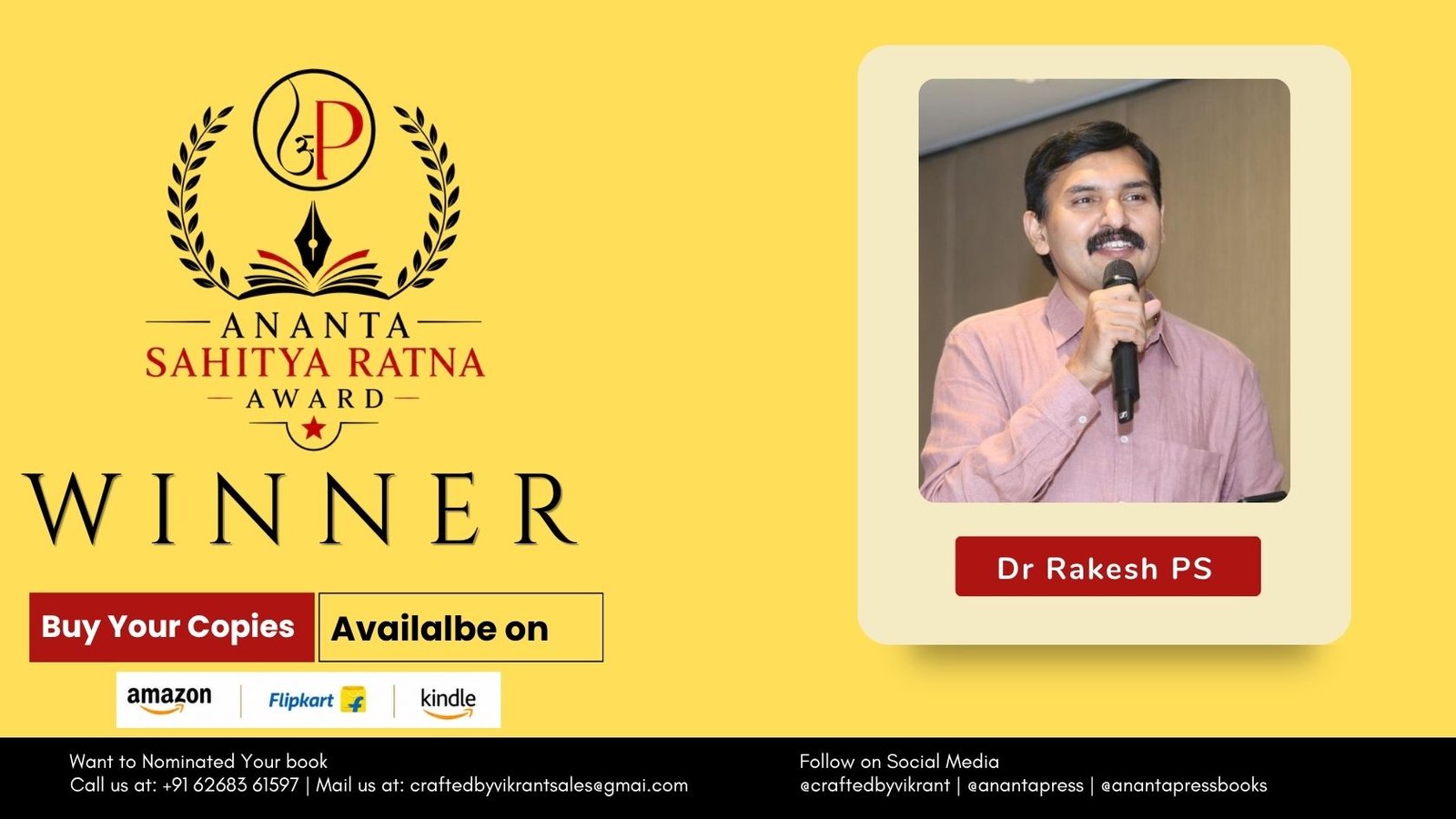
Ananta Press is delighted to congratulate Dr Rakesh PS on being officially selected as a Winner of the Ananta Press Sahitya Ratna Award for his remarkable book, Echoes from the Atoll: Inside India’s First TB-Free Islands.
This recognition celebrates a book that succeeds not only as a public health narrative, but also as a sensitive literary memoir about people, place, identity, belonging and social change. Set in Lakshadweep, the book emerges from Dr Rakesh PS’s years of experience as a public health professional during the islands’ journey towards TB-Free certification under India’s sub-national certification initiative.
What makes Echoes from the Atoll especially distinctive is the way it moves beyond conventional accounts of public health achievements. Instead of presenting tuberculosis elimination mainly through programme data, statistics or technical frameworks, Dr Rakesh PS brings readers close to the people who made this achievement possible. Health workers, ASHAs, families and community leaders become the centre of the narrative. Their efforts show how a health programme can become a shared community aspiration when people begin to believe that disease does not have to remain a permanent part of their lives.
The Ananta Press Sahitya Ratna Award recognises literary works that demonstrate originality, meaningful contribution, reader value and the ability to leave a lasting impression. Echoes from the Atoll strongly reflects these qualities. The award committee found the book especially noteworthy because it brings together public health, travel writing, personal reflection and social observation within one deeply human narrative.
Lakshadweep itself becomes an important character in the book. The sea, changing weather, geographical distance and movement between islands influence not only everyday life but also the way healthcare must be planned and delivered. The reader begins to understand that solutions designed for mainland settings cannot always be transferred unchanged to island communities.
Another important quality recognised by the committee is the book’s exploration of tradition and modernity. Dr Rakesh PS observes a society negotiating change while trying to preserve its cultural identity. Questions about development, aspiration, memory and heritage appear naturally throughout the narrative. These reflections give the book significance far beyond the subject of tuberculosis.
At an even deeper level, Echoes from the Atoll asks what it means to belong somewhere. It examines how people respond when the place they consider home begins to change and how communities move towards the future while trying to retain a sense of who they are.
The international release of the book on July 29, 2026 by Dr Lucica Ditiu, Executive Director of the Stop TB Partnership hosted by the United Nations Office for Project Services in Geneva, in the presence of global health leaders, further reflects the relevance of its central story.
Through Echoes from the Atoll, Dr Rakesh PS has transformed an important public health achievement into an accessible human story. TB provides the backdrop, Lakshadweep provides the setting, but the people remain at the heart of the narrative.
The Ananta Press Sahitya Ratna Award committee warmly congratulates Dr Rakesh PS on this recognition and wishes him continued success in his literary and professional journey. His work demonstrates how lived experience, careful observation and compassionate storytelling can bring important social achievements closer to readers and preserve the stories of communities for future generations.
Review Committee Feedback
Glenville Ashby
Echoes from the Atoll impressed me because it approaches public health through the lives of ordinary people rather than through technical language. Dr Rakesh PS allows the reader to understand the TB-Free journey of Lakshadweep by showing the effort of health workers, families, ASHAs and community leaders. This makes the achievement feel real and personal. I particularly appreciated the role of geography in the narrative. The sea, distance between islands, uncertain travel and weather are not simply background details. They influence how people live and how healthcare reaches them. The book therefore gives the reader a clear sense that public health solutions must respond to the realities of the community they serve. At the same time, the writing remains reflective and accessible. A reader does not need a medical or public health background to connect with the book. Its greatest strength is its humanity. It records an important health achievement while ensuring that the people behind that achievement are never forgotten.
Kavya Pandey
What stayed with me while reading Echoes from the Atoll was its strong sense of place. Lakshadweep is presented not as an attractive location added to a public health story, but as a living environment that shapes every part of the narrative. Dr Rakesh PS helps readers experience something of the distance, sea journeys, relationships and rhythms of island life. The book also succeeds in connecting these observations with larger questions about identity and belonging. I found the sections dealing with tradition and modernity especially thoughtful. Communities naturally change with time, but change also creates questions about what should be preserved and what may slowly disappear. The author treats this subject with sensitivity rather than giving easy answers. The TB-Free achievement gives the book an important social foundation, but the narrative reaches much further. It becomes a story of communities adapting, protecting their identity and working together. This combination of personal reflection, social observation and public health gives the book its distinctive literary value.
Apeksha Gupta
I found Echoes from the Atoll valuable because it makes a subject that could easily become technical very easy to understand and emotionally engaging. Tuberculosis elimination is a major public health issue, yet Dr Rakesh PS does not overwhelm the reader with statistics or complicated programme descriptions. Instead, he introduces us to the people who carried the mission from one household to another. Through health workers, ASHAs, families and local leaders, readers understand that major health achievements are built through trust, patience and community participation. Another strength is the author’s ability to connect his professional experience with personal reflection. His time in Lakshadweep clearly changed the way he understood the islands and perhaps also the meaning of his own work. That personal dimension gives warmth to the narrative. The book also encourages readers to think about how geography, culture and social relationships affect healthcare. It is informative without feeling like a textbook and reflective without losing sight of the real achievement at its centre.
Kavita Kaushik
For me, one of the strongest aspects of Echoes from the Atoll is the way it places people before programmes. The TB-Free certification is an extraordinary achievement, but Dr Rakesh PS carefully reminds readers that such recognition becomes possible only because many individuals work quietly for years. The contribution of frontline workers and communities receives meaningful space in the book. I also appreciated the author’s observations about changing island life. Modern aspirations can bring opportunity, but they can also change customs, relationships and ways of living that have developed over generations. The book captures this tension with care. It neither romanticises the past nor treats every form of change as automatically positive. Instead, it encourages readers to observe and think. The language is approachable, and this allows the story to reach people beyond the public health field. Readers interested in travel, communities, social change or personal memoir can also find something meaningful here. It is this broad human appeal that makes the book memorable and deserving of recognition.
Neel Preet
Echoes from the Atoll stands out because it brings several kinds of writing together while still maintaining a clear emotional centre. It can be read as a memoir, a record of a public health achievement, an account of island life and a reflection on belonging. Yet these different elements do not feel disconnected because they are all linked through the author’s experiences in Lakshadweep. I especially liked the idea that place itself can shape healthcare. The challenges created by the sea and the physical separation between islands help readers understand why health systems must be adapted to local realities. The book also shows that eliminating a disease requires more than medical intervention. It requires trust, communication and the participation of communities. Dr Rakesh PS gives appropriate importance to these human relationships. The book has a quiet but meaningful message about collective action. It shows how an ambitious public health goal can gradually become a community’s own aspiration. That makes the achievement both inspiring and deeply relatable.
Deepak Seth
After reading Echoes from the Atoll, I felt that its most important contribution is the preservation of a story that could otherwise have remained confined to official reports and public health records. Lakshadweep becoming TB-free is significant, but Dr Rakesh PS shows us what such an achievement looks like when viewed from the level of communities and individual lives. His narrative gives recognition to the people whose daily efforts helped turn a health objective into reality. I also found the question of belonging particularly powerful. The book asks readers to consider what makes a place home and what happens when that place begins to change. These are universal questions even though the story is rooted in a very specific geography. This balance between the local and the universal gives the book considerable strength. Readers learn about Lakshadweep and tuberculosis elimination, but they are also encouraged to reflect on identity, community, memory and change. It is a thoughtful and original work with lasting social and literary relevance.